No evidence pack accompanies this topic, so a ranked list of humanoid robot breakthroughs would risk making up the part that matters: proof. The useful question is narrower: which technical gains would change what a humanoid robot can do at work?
- Walking that stays stable while carrying a load
- Hands that repeat the same task without teleoperation
- Batteries, safety systems, and repairs that fit a real shift
Walking is only the first test
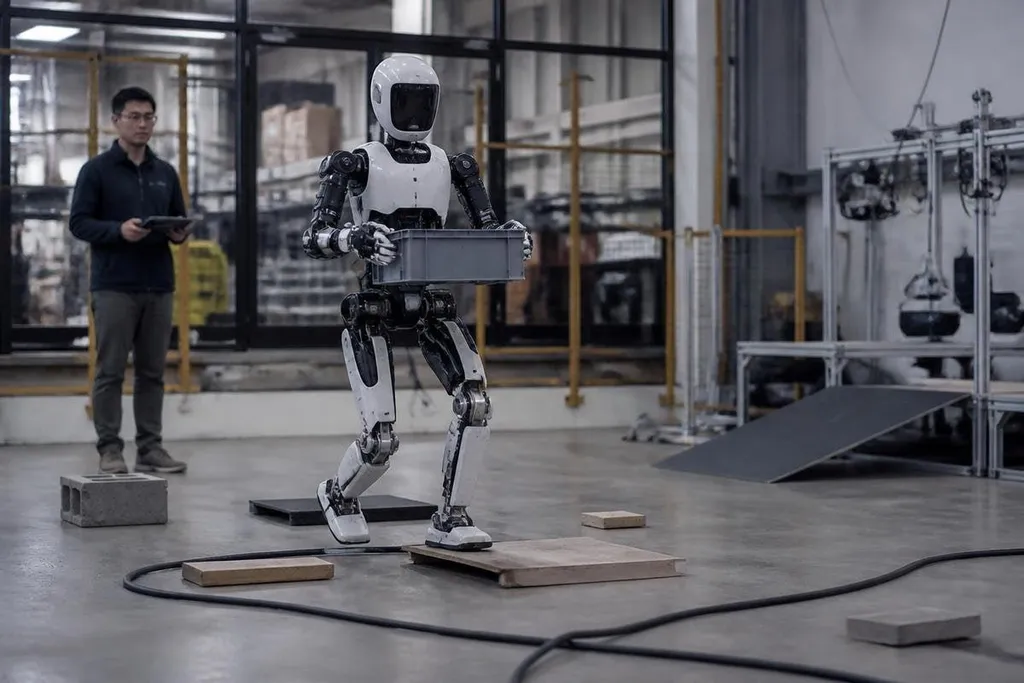
A humanoid robot needs to keep its balance while it turns, stops, steps over gaps, and carries an object. A smooth walk across a clear floor says little about work on a plant floor, where cables, ramps, loose items, and people change the robot’s path.
The test to watch is recovery. After a small push or a missed foothold, does the robot stop safely and regain balance? A useful report should state the floor type, load, walking speed, number of attempts, and how many failures occurred.
That detail matters because walking uses power and time. If a robot needs a remote operator whenever the floor changes, the task has moved back to a person at a control station.
Hands and task work
Humanoid hands will matter when they can repeat a task across many objects, lighting conditions, and positions. Picking one known item from one fixed shelf is a narrow test.
Sorting mixed parts from a bin is closer to the problem factories and warehouses need to solve. Look for the full task record: object types, cycle time, success rate, recovery steps, and the share of work done by a remote operator.
A short video can show motion; it cannot show how often the motion works. The robot also needs to know when a grip is failing.
Force sensors measure contact at the fingers, while cameras help locate the object. The useful gain comes when those systems work together without a person correcting every move.
Sensor results matter more when a humanoid’s battery runtime and safety record sit beside the task. Robot24 can point you to dated reports on named machines before the next section asks whether one can keep working after a fault.
Battery, safety, and repair
A robot that walks and handles objects still needs enough battery power for its assigned work. Watch for measured run time during a named task, recharge time, battery swap time, and the load carried during the test.
Empty walking time gives a poor picture of a work shift. Safety is part of the machine, not a note added after the demo.
A useful system should stop when a person enters its path, limit force at the hand, and record faults for later review. The report should name the safety method and the setting where it was tested.
Repair also deserves attention. A broken wrist joint can stop a task even when the rest of the robot works. Buyers need part prices, service steps, software support, and a clear answer on who fixes the robot after delivery.
How to judge the next claim
The best-supported announcements will connect a technical change to a repeatable task. Use this order when reading a company release or watching a video:
- Find the task. Identify what the robot had to lift, carry, sort, or place.
- Check the setting. Look for floor type, lighting, load, workspace, and people nearby.
- Count the human inputs. Separate full autonomy from remote control and manual resets.
- Ask for failure data. A success rate without the number of attempts tells little.
- Check the price. Include the robot, gripper, software, support, and spare parts.
Before treating a humanoid robot as ready for work, check these points:
- Repeatable testing: the robot runs the task for a stated period.
- Failure handling: the report explains what follows a dropped object or missed step.
- Human input: each cycle shows how much remote control it needs.
- On-site repair: a technician can replace a failed part at the work site.
- Published limits: the seller lists safety limits and service costs.
I'd skip any claim that shows a polished clip but leaves out task results, failure counts, and human input.
The next useful humanoid advance won't need a grand label. It will come with a named task, a repeatable test, a repair plan, and numbers another team can check.